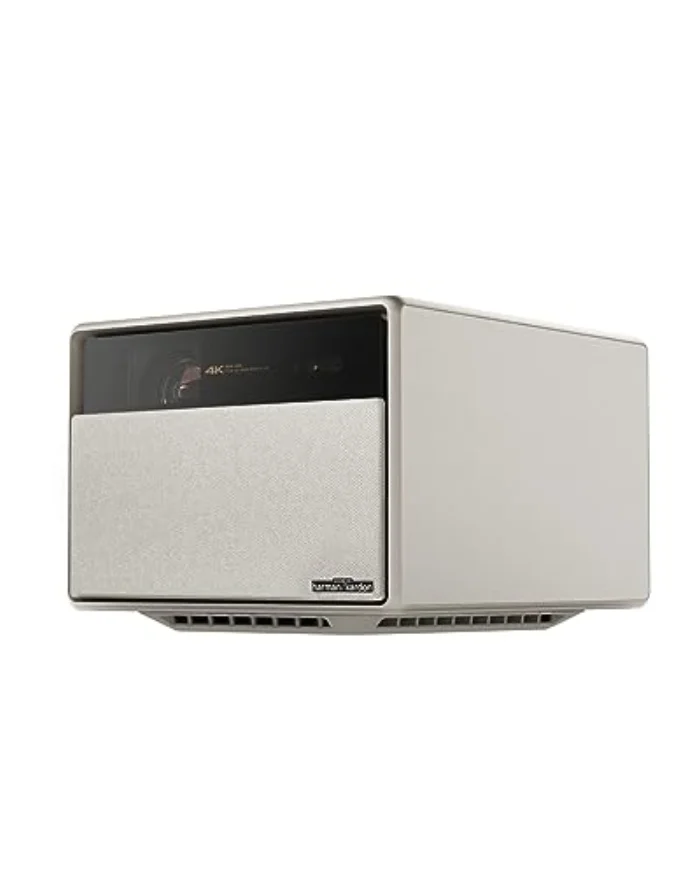
Most projectors are a component in a system: you add a source, you add sound, you square the image up by hand. The XGIMI Horizon Pro is built to be the opposite, a single box that streams, plays its own sound and sets itself up. It runs Android TV, has a genuinely good pair of Harman Kardon speakers, focuses and keystones itself automatically, and uses an LED light source with no lamp to ever replace. The catch is brightness: it is the dimmest projector on our test, so it needs a dark room. In one, it is the most effortless projector to live with.
XGIMI Horizon Pro: full specifications | Display technology | Single-chip DLP, LED light source |
|---|
| Resolution | 4K UHD (3840 x 2160) |
|---|
| Rated brightness | 2,200 ISO lumens |
|---|
| Measured brightness | 1,510 ANSI lumens |
|---|
| Contrast ratio | 1,500:1 |
|---|
| Throw ratio | 1.2:1 |
|---|
| Image size | 40 to 200 in (2.5 m wide at 3 m) |
|---|
| Light source life | 25,000 hours (no bulb change) |
|---|
| Smart TV | Android TV 10 built in |
|---|
| Audio | 2x 8 W Harman Kardon speakers |
|---|
| Running noise | ~32 dB |
|---|
| Weight | 4.3 kg |
|---|
| Typical UK price | £1,299 |
|---|
Who is the XGIMI Horizon Pro for?
The Horizon Pro is the right projector if you want the least possible faff and have a room you can darken. It suits the person who wants to put one tidy box on a coffee table or a shelf, turn it on, and have streaming, sound and a squared-up 4K picture all just work, without a streaming stick, a soundbar or a manual setup. The built-in Harman Kardon speakers are good enough that you can genuinely watch a film without separate sound, which no other projector here can claim, and at around 32 dB it is the quietest unit on test. For a calm, blacked-out living room or a dedicated cinema where convenience matters as much as the picture, it is the most pleasant projector to own.
It is less suited to two groups. If your room gets any real light, its measured 1,510 ANSI lumens is simply not enough, and the picture will look soft and washed out; the brighter Optoma UHD38 or Epson EH-TW7100 are the right answers there. And if you want the very best black levels and contrast, its modest 1,500:1 native contrast trails the dedicated cinema projectors. For an effortless box in a dark room, though, it is the standout.
How the XGIMI Horizon Pro performs
The all-in-one experience
This is what you are paying for, and it is very well executed. Android TV 10 is built in, so Netflix, Disney+, YouTube and the rest are there from the start with no extra hardware. The auto-focus and 8-point auto-keystone square the image up by themselves within a few seconds of being moved, so you can sit it almost anywhere and get a tidy picture. And the twin 8 W Harman Kardon speakers are a real surprise: clear, with proper bass for the size, and loud enough to fill a normal room. Together these make it the only projector here you can unbox and use, fully, with nothing else added.
Picture and brightness
In a dark room the 4K picture is clean, detailed and pleasant, with good colour and smooth motion. But brightness is the honest weakness: despite a 2,200 ISO lumen rating, we measured 1,510 ANSI lumens, the lowest of any projector on test. That is plenty for a fully blacked-out room, where it looks lovely, but it has nowhere near the output to fight ambient light, so with the curtains open or a light on the picture quickly turns soft and grey. The native contrast of 1,500:1 is also modest, so blacks look more dark-grey than inky. Treat it as a dark-room projector and it impresses; ask it to work in a bright room and it disappoints.
Light source and running costs
The LED light source is rated at around 25,000 hours, so unlike the lamp-based Epson and Optoma there is no bulb to buy, ever. At a few hours of viewing a day that is well over a decade of use, which makes the running costs effectively nil after purchase, a genuine long-term saving. The LED also turns on instantly with no warm-up, and contributes to the quiet 32 dB running noise.
The honest downsides
There are three. First and most important, it is the dimmest projector here at a measured 1,510 ANSI lumens, so it really needs a dark room; this is the one to avoid if your room is bright. Second, the native contrast is modest at 1,500:1, so black levels are good rather than great. Third, at £1,299 it is the most expensive projector on test, and you are paying for the convenience and the LED, not outright brightness or contrast. If you value ease and a long-life light source over raw picture punch, that is a fair trade; if you do not, a brighter, cheaper cinema projector makes more sense.
The good
- True all-in-one: Android TV, sound and autofocus built in
- Genuinely good Harman Kardon speakers
- LED light source rated 25,000 hours, no bulb to replace
- Quietest projector on test at around 32 dB
- Slick, living-room-friendly design
The not-so-good
- Dimmest on test at a measured 1,510 ANSI lumens
- Needs a properly dark room to look its best
- Modest 1,500:1 native contrast
- Most expensive projector here at £1,299
Best for: the buyer who wants a fuss-free all-in-one box in a dark room and values streaming, sound and autofocus built in. Not the pick if your room gets real light (try the Optoma UHD38) or you want the deepest blacks.