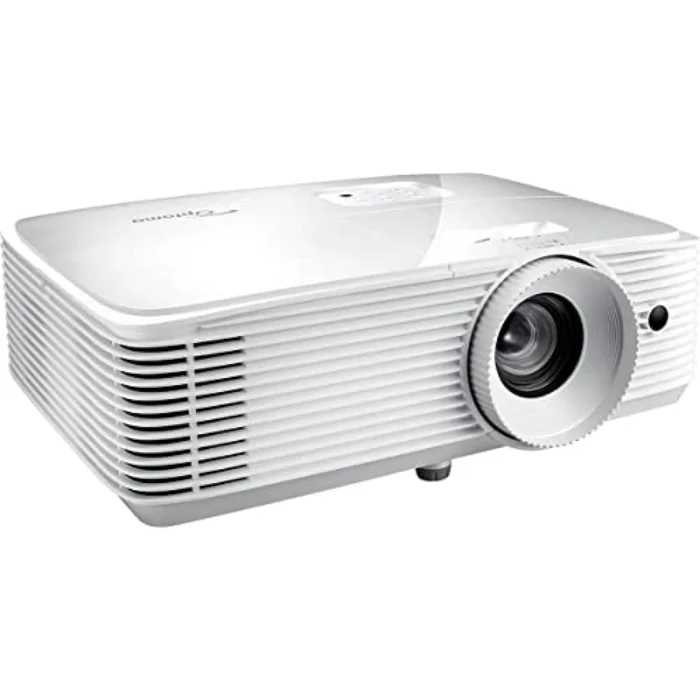
Most UK living rooms never fully black out, and that is where the majority of cheaper projectors fall apart, washing out to a flat grey the moment any light gets in. The Optoma UHD38 is the answer to that: it is the brightest projector on our test by a clear margin, it is 4K UHD with HDR, and it doubles as a quick-responding gaming projector, all for under £1,000. It is not the most refined picture in a pitch-dark room, but for a real-world room with real-world light, it is the most flexible projector here.
Optoma UHD38: full specifications | Display technology | Single-chip DLP |
|---|
| Resolution | 4K UHD (3840 x 2160, XPR) |
|---|
| Rated brightness | 4,000 ANSI lumens |
|---|
| Measured brightness (bright) | 3,290 ANSI lumens |
|---|
| Contrast ratio | 1,000,000:1 dynamic |
|---|
| Throw ratio | 1.21 to 1.59:1 |
|---|
| Image size | 34 to 302 in (2.48 m wide at 3 m) |
|---|
| Input lag (1080p/240) | 4.2 ms |
|---|
| Input lag (4K/60) | 16.9 ms |
|---|
| Lamp life (Eco) | 15,000 hours |
|---|
| Refresh rate | Up to 240 Hz at 1080p |
|---|
| Weight | 4.0 kg |
|---|
| Typical UK price | £999 |
|---|
Who is the Optoma UHD38 for?
The UHD38 is the right projector if your room gets a lot of light and you do not want to spend over £1,000. It is the unit to choose when you cannot fully cover the windows, when there is always a lamp on somewhere, or when you simply want the picture to look bright and alive in the evening without blacking the room out completely. It is also a strong all-rounder for someone who games as well as watches films, thanks to its very low input lag. For the buyer who wants the most picture-for-the-money in a normal, lived-in room, it is the obvious pick.
It is less suited to two groups. If you have a dedicated, fully dark cinema room, the 3LCD Epson EH-TW7100 has deeper, more convincing black levels and no rainbow effect, which matter more once the lights are off. And if you need to place a projector off-centre, the UHD38's lack of lens shift will bite, since it only offers a small zoom and vertical keystone. For a bright room where you can position it reasonably square-on, though, it is hard to beat for the price.
How the Optoma UHD38 performs
Brightness and ambient light
This is its headline strength. We measured 3,290 ANSI lumens in its brighter modes, comfortably the highest of any projector on test, which is exactly what you need to fight ambient light. With the curtains drawn it looks punchy and colourful, and even with a little daylight or a side lamp it holds a watchable picture where dimmer projectors give up. That ambient-light tolerance is the single biggest reason it is our value pick: it works in the rooms most people actually have, not just an idealised dark cinema. The 4K UHD resolution is sharp, and HDR content has plenty of headroom thanks to all that brightness.
Gaming
It is a surprisingly capable gaming projector. In its Enhanced Gaming mode the input lag drops to about 4.2 ms at 1080p and 240 Hz, and around 16.9 ms at 4K and 60 Hz, figures that put it right alongside dedicated gaming projectors like the BenQ TK700STi. Combined with the high brightness, that makes it a genuinely good films-and-games machine for a bright room, which is a rare combination at this price.
Placement, noise and lamp life
The UHD38 is a standard-throw projector that needs roughly the depth of a normal living room to fill a 100-inch screen, with a modest 1.1x zoom for fine adjustment. There is no lens shift, so you do need to position it carefully and rely on vertical keystone for height, which is the main compromise for the price. Fan noise rises noticeably in the brightest mode, which is the trade for that light output, but steps down in Eco. The lamp is rated at a long 15,000 hours in Eco, keeping running costs low over its life, and at 4.0 kg it is a manageable size for a shelf or ceiling mount.
The honest downsides
There are three. First, the black levels are not as deep as the 3LCD Epson's in a fully dark room; in a bright room you will not notice, but in a blacked-out cinema the Epson looks more convincing. Second, there is no lens shift, so placement is fussier and off-centre installs are awkward. Third, in its brightest mode the fan is audible, which is fine in a bright living room but less ideal in a silent dark room. These are sensible trade-offs for a bright 4K projector under £1,000, not deal-breakers, but worth knowing before you buy.
The good
- Brightest on test at a measured 3,290 ANSI lumens
- Copes with ambient light better than anything here
- Fast 4.2 ms input lag at 1080p/240 Hz for gaming
- 4K UHD and HDR for under £1,000
- Long 15,000-hour Eco lamp life
The not-so-good
- Black levels trail the 3LCD Epson in a dark room
- No lens shift, only keystone and a small zoom
- Fan noise rises in the brightest mode
- No built-in smart TV (add a streaming stick)
Best for: the buyer with a bright, lived-in room who wants the most picture-for-the-money and a projector that games well too. Not the pick if you have a fully dark cinema room (the Epson's blacks win) or need to place it off-centre.