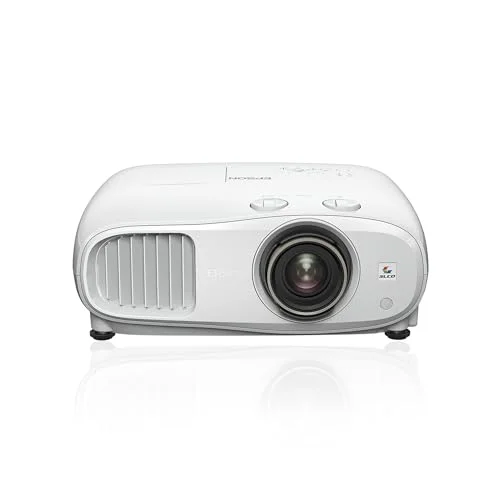
Epson EH-TW7100: full specifications | Display technology | 3LCD (3-chip) |
|---|
| Resolution | 4K PRO-UHD (pixel-shifted 1080p) |
|---|
| Rated brightness | 3,000 ANSI lumens |
|---|
| Measured brightness (cinema mode) | 2,180 ANSI lumens |
|---|
| Contrast ratio | 100,000:1 dynamic |
|---|
| Throw ratio | 1.32 to 2.15:1 |
|---|
| Image size | 40 to 500 in (2.66 m wide at 3 m) |
|---|
| Input lag (1080p/60) | 20.4 ms |
|---|
| Lamp life (Eco) | 5,000 hours |
|---|
| Lens shift | Vertical and horizontal |
|---|
| Weight | 6.6 kg |
|---|
| Typical UK price | £1,199 |
|---|
Who is the Epson EH-TW7100 for?
The EH-TW7100 is the right projector if you want one proper home cinema unit for a living room that you can darken reasonably well, and you value a clean, accurate picture over gimmicks. It is a full home cinema projector rather than a portable, so it wants a permanent home, either on a shelf at the back of the room or mounted on the ceiling, and it expects you to feed it from a streaming stick, a games console or an AV receiver. For someone building a film-first room around a 100-inch screen, it is a near-ideal centrepiece, and the lens shift means you do not have to rearrange your furniture around it.
It is less suited to two groups. If you want a grab-and-go projector for the garden or a box that streams and plays sound on its own, this is not it: there is no battery, no built-in smart TV and no real speaker, so look at the Anker Nebula Capsule 3 or the all-in-one XGIMI Horizon Pro instead. And if your room is permanently bright, with windows you cannot cover, the brighter Optoma UHD38 will hold up better. For a darkenable living room, though, the Epson is the most rounded choice.
How the Epson EH-TW7100 performs
Picture and brightness
The 3LCD light engine is the whole story here. Because it never uses a spinning colour wheel, there is no rainbow effect at all, which is a relief if you are one of the people who sees those flashes of colour on single-chip DLP projectors. We measured 2,180 ANSI lumens in its accurate cinema mode, which is bright enough to look good in a living room with the curtains drawn and only loses out to the picture in a fully blacked-out room, where it really shines. The pixel-shifted 4K resolution looks genuinely sharp from a normal sofa distance on a 100-inch screen, motion is clean, and HDR content has decent punch. Best of all, the colour out of the box is close enough that most owners never feel the need to calibrate.
Placement and setup
This is where the EH-TW7100 earns its top spot. It has both vertical and horizontal lens shift, a feature that is rare at this price, which means you can sit it on a side shelf or off to one side and still slide the image into the right place optically, with no keystone correction and therefore no loss of sharpness. The 1.6x zoom gives you a sensible range of distances, so it fits a wider variety of rooms than a fixed-throw projector. At 6.6 kg it is a substantial unit that wants a solid shelf or a proper ceiling bracket, but once it is placed, lining the picture up is the easiest of any projector here.
Gaming and running costs
It is primarily a film projector, but the 20.4 ms input lag at 1080p/60 is low enough for casual and even moderately serious gaming; it is not a twitch-shooter machine like the BenQ TK700STi, but it is perfectly playable. The lamp is rated at 5,000 hours in Eco mode, which at a few hours a day is several years of viewing before a bulb change, and replacement lamps are widely available. Running noise is moderate and drops noticeably in Eco, so it sits quietly in a living room.
The honest downsides
There are three worth knowing. First, it is lamp-based, so unlike the LED and laser projectors here it will eventually need a bulb, a running cost the XGIMI and Anker avoid entirely. Second, there is no built-in smart TV or usable speaker, so you must supply both a source and sound, which is normal for a dedicated cinema projector but means a little more kit. Third, at 6.6 kg it is the heaviest unit here and is firmly a fixed-install projector, not something you move around. None of these is a flaw in the picture; they are simply the trade-offs of a proper home cinema projector that puts its money into the light engine and the optics.
The good
- 3LCD means no rainbow effect and full colour brightness
- Measured 2,180 ANSI lumens holds up with curtains drawn
- Vertical and horizontal lens shift for flexible placement
- Sharp pixel-shifted 4K with accurate out-of-box colour
- 5,000-hour Eco lamp and quiet running
The not-so-good
- Lamp-based, so a bulb change is needed eventually
- No built-in smart TV or usable speaker
- Heavy 6.6 kg body wants a permanent install
- Out-paced for outright brightness by the Optoma
Best for: the buyer building a film-first living room they can darken, who wants a clean, accurate, rainbow-free picture and flexible placement. Not the pick if you need a portable (try the Anker Capsule 3) or a permanently bright room (try the Optoma UHD38).